Separate and Blend

Something that is very close to my heart is the subject of divorce and blended families. My father was raised in a divorced home and blended family, and I can see how this affect him. There were many hard things that resulted from this, but then there were many fantastic things.

Today I would like to focus on the studies of divorce and how to successfully create a blended family.

Divorce:

There was a questionnaire sent out to married couples that had them rate their marriage from very satisfied to very dissatisfied. The same questionnaire was then sent out ten years later and there were some surprising results recorded. 70% of those whom had said that they were very dissatisfied or dissatisfied with their marriage, now reported that they were satisfied or very satisfied with their marriage.

What happened?

Well, it turns out that if couples were to stick out their marriage for at least five years, they would be surprised to see how much their marriage could change to their satisfaction, but to many people decide to divorce before then.

Now I am not saying that every couple should try to workout their marriage. There are some cases were divorce would be the better option, such as spouse abuse, their children being abused, threat to wellbeing, etc. But there are also many cases where the marriage could have been saved, but wasn’t because divorce was an option.

Divorce hasn’t always such a frequently chosen option. It wasn’t until California, in the 1970s, passed No-Fault divorces as legal, that we began to see an increase in divorces. Before No-Fault Divorces were introduced, one would have to prove to the court that their spouse was abusive, was addicted to alcohol or drugs, was unfaithful, or had deserted the family. Now, the spouse just simply needs to say that they want a divorce and the court considers this legal action. It seems like such an easy process, but what people do not realize is that there is a lot more that goes into divorce that what one thinks.

First off, on average, it costs around $125,000 to be divorced. Only $25,000 would go towards the legal fees while the rest of the money would go to child support and another other expenditures required for the separation of blended lives.

Second, there are stages of divorce that need to be addressed.

  • Emotional divorce: Separating your emotions from your former spouse.
  • Legal divorce: the legal separation.
  • Economic divorce: the separating of economic goods.
  • Co-parenting divorce: the separation and dividing of parenting rights.
  • Community divorce: the disconnect from the social support you received as a married couple.
  • Psychic divorce: the acceptance that you will no longer be together.

Every person who experiences a divorce will have to go through these stages and it can be exhausting.

Third is this surprising statement, 67 percent of those that have gotten a divorce now wish that they had tried to save the marriage. Divorce can leave you with quite a bit of regret. Why is that? It is because most marriages can be saved if a bit of effort and work is put into it.

Blended families:

Here are three simple suggestions for blended families.

  1. It take a minimum of two years for a family to successfully blend. This a process of time and love. There is no rushing a successful blending of families.
  2. Let the actual parent do all the harder discipline. As a foster parent, you are new to the child’s life and you do not have a present foundation to work from. They will peg you as the bad guy and will most likely not respect your wishes since you are not their “parent”.
  3. Be the fun uncle or aunt, instead of the parent. Again, you need to build a foundation. This is not going to come naturally, so it is best that you approach it from a relative side instead of stepping into the parenting role from the get go. Be the listening ear and the helping hand. Let them know how much you respect their parent and they will come to respect you.

These are just three simple suggestions given that will hopefully give you direction on blending your family.

But if there is an option to keep the original family together, then this option should always be taken.  
Are we meeting their needs?

Something that I have always found fascinating is the affect parents have on their children, but what I have found even more fascinating is the reasons behind parenting.

Why do we parent?

John Hopkins says the reason why we parent is to prepare our children to survive and thrive in the world that they will live in. Every good parent wants their child to have every possible chance of success and happiness in this world, but we are not all going to parent the same because we each perceive our environment in a different light. For my mom, her parents would let her go out and wander around the neighborhood, but my dad was punished pretty harshly if he strayed from home or if he talked back. Why is this? Where my dad’s parents just trying to control my dad. No, they were just simply preparing him for the world he was going to live in. You see, my dad was raised in Peru in the poor parts of Lima. Unlike the environment that my mom lived in, wandering around the neighborhood was dangerous and you needed strict obedience in order to survive and thrive there.

We parent to prepare and protect our children.

Even though we parent in many different ways, there are still some basic needs that all children need met. John Hopkins suggests 5 main needs.

When you think about needs, you probably think about the needs related to sleep, food, shelter, clothes, etc. When we talk about children’s development needs, it is completely different.

Here they are.

  • Contact and Belonging: Every child needs to be touched in loving ways and feel that they are wanted and needed. There have been countless studies that show that babies who do not experience physical contact, develop malformations of the body and lack social skills. There was once a phenomenon that happened in a hospital. There were two wings that were close to identical, but one wing was suffering a significant amount of infant fatalities than the other. Nobody knew why. They tried deep cleaning the facility, switching staff, looking at ever possible difference but nothing changed. One night, a doctor has stayed later in the wings to finish up some work before going home, when he noticed a cleaning lady walking through the babies and just gently caressing them and talking to them. She occasionally would pick one up and then gently set them back down in their cribs. The doctor approached her and asked her how long she had been doing this. She replied, “for months now”. The doctor immediately had her switched to the other wing and the result was drastic. The wing that had less infant fatalities began to have more and the other wing that had been experiencing a significant number of infant fatalities, began to see less and less infants dying.

What does this tell us? Contact is vital. Parents should offer contact freely. If they do not, children may develop an undue attention seeking behavior, or in other words, doing things to get attention that may be annoying or potentially dangerous.

  • Power: Children should be given an amount of power. Hopkins calls this Response-Ability, or the ability to respond. Parents should allow children to make choices and then let the consequence follow, good or bad. Children who are not given power have a tendency to be more rebellious or seek to control others.
  • Protection: Every child deserves and needs to feel safe. That doesn’t mean that we fight their battles, but we give them a safe palace to come back too and to learn how to fight their battles.  The best thing a parent can do is to teach them how to be assertive and to forgive.  We can do this by creating situations where they are allowed to express their opinions and thoughts. We can ask them what they think of different matters and help them learn to express them in constructive ways. Children whose need of protection is not met will seek revenge.
  • Withdrawal: Everyone needs to take a break sometimes and children should be allowed to take one as well. We need to help them recognize when a break is needed and when we need to come back to a task. Parent can do this in leading by example. If you two are working together, verbally say something like “we are going to take a 15min break” and then take it, and then come back. Children who do not learn to withdrawal may develop undue avoidance, meaning that they will isolate themselves.
  • Challenge: Children need to be challenged and feel pride in overcoming their challenges. Parents should not try to ease the challenge if the child is fully capable of meeting it. If they do, children may develop avoidance to challenges.

When we meet these needs, we better prepare our children for the world that they will be living in.

Fathers

How important are fathers?

Well, let us look at some points that have been made in regards to this question.

  1. Father involvement with pregnancy
    1. Most of the time, the pregnancy period is focused on the mothers and the fathers are very much left out. In Gottman’s book, Raising an Emotionally Intelligent Child, he says, “Studies show that a dad’s involvement in his partner’s pregnancy can help set the stage for a whole series of positive family interactions that benefit the marriage, benefit the child, and strengthen the father-child bond.” (pp. 174).
  2. Father influence on Sons
    1. A study was done in the Tshwane district on the effect of the level of son-father attachment. The results indicated that fathers who were good role model and had a good attachment to their sons did not change their behavior drastically in anyway, but the sons of the father’s that did not have a secure attachment showed more tendencies to misbehave, experiment with drugs, develop physical and emotional health problems. The researchers stated “Fathers are perceived as the primary sources of explaining basic societal rules to their sons (external socialization). Boys tend to be heavily involved emotionally with their fathers as role models. They look up to their fathers about how to act out their male roles.”
  3. Father influence on Daughter
    1. Another study was done on biological father absences and teen pregnancy or sexual activity. The results indicated that those with father’s absent from the home, were more likely to be sexually active and/ or become pregnant at earlier ages then those who had their biological father in the home.
  4. Emotion and fathers
    1. They create situations which help the children learn how to manage and act upon their emotions. For example, fathers tend to rough house with the kids which can help them learn how to manage the excitement and what behaviors are appropriate.
  5. Mother- Father Relationship
    1. How a father treats a mother, has a huge influence on the children. It models to the children how a man should treat a woman and what a woman should expect out of a man. Those who do not have father or do not have father that honor the mother miss out on these vital lessons.

I have seen these points with my own father. He was very much involved in our lives and I had a very special bond with him. I learned from him how I should be treated by a male and I find myself comparing the way other males treat me to how my dad treated my mom. I also learned from our roughhousing sessions how to regulate my emotions and to control my behaviors. There were quite a few times that I would smack him in the face or bite down on his arm. I learned quickly that those weren’t appropriate reactions.

Another interesting thing that I observed was that the way he parented us was directly influenced by the way he was parented. He didn’t really have a father in the home growing up since his parents divorced. It was always stepfathers. Something that I observed about my dad is that he is not good with emotions and I due that to the fact that his father was not available or willing to provide emotional coaching. My dad also has a hard asking for help or admitting that he needs help. He was expected to be the man of the house growing up, since there was no stable male figure in the house and receiving help of any kind is a sign of weakness. These are some weaknesses that I have observed, and I do really think that not having a solid male figure in his life is the root.  

But something I do admire about my dad is the fact that even though his father didn’t stick around, he did, and he has been such a blessing in our lives. I want to ensure that this happens in my family and that my children have a dad to look up too. Some of the steps, I am taking is dating wisely right now. I look for those who have a desire to be fathers and have ambition. I always ask myself, “would I want this man to be the role model for my children”. This question always determines whether I will continue to go out with that person.

Some other things that I am planning to do it to make sure that he is involved in every aspect of our children’s lives. Everything from the pregnancy to our children’s graduation. He is going to be involved in the baby shower, the parenting classes, the discipline decisions, everything! My plan is to work as a team with him so that our children have no doubt that we love each other and that we are in this together.

Councils and Communication

David D. Burns presented “Five Secrets of Effective Communication “ and I would like to share them with you today.

  1. Use the Disarming Technique
    1. In other words, find some truth in what the person is trying to say, even if you think it seams to be unreasonable or untrue.
  2. Empathize
    1. Empathizing is very different then sympathizing. When we empathize, we are putting ourselves into their shoes and seeing thing as they see them. We can do this in two ways. We can use thought empathy (paraphrasing and repeating back what they said) or we can use feeling empathy (acknowledging the feelings that the individual has about the matter, based on what he or she has said).
  3. Inquire
    1. Ask questions but be gentle about it. Try to really understand what they are thinking and feeling.
  4. Use “I feel” statements
    1. When you use “you” statements, it opens the door for the hurt feelings and the other person to become defensive. An example of a “you” statement would be “you never clean up after yourself”. When we use “I feel” statements, it allows you to express your feeling and thoughts with tact and without the evoking negative feelings from the other individual. If you are not sure where to start, use this simple formula. When (blank) I feel (blank) because (blank) I would like (blank). Very simple format that could save you a lot of trouble in the long run.
  5. Use stroking
    1. Stroking their ego. Their sense of worth. How does one do this? Simply by finding something genuinely positive to say, especially during an argument. Make sure that you are letting them know that you respect them even if you are feeling negative emotions in the moment.  

These are great ways to take a possibly tense conversation to a constructive conversation. I would highly suggest using them.

Along with good ways to communicate, something so vitally important is to hold family council. I know I mentioned it briefly last week, but now I would like to go more into depth on how to hold a family council.

For those who are not religious, there may be some steps in here that you would not want to implement. That is alright, you can find alternatives to those steps, but for those who are not opposed, I highly suggest following these steps.

  1. Plan a weekly day and time for your council.
    1. Having a set day and time will help you avoid the awkwardness of having to come up with a last-minute meeting in order to address an issue or family concern. Instead, it will just be expected. Council should be use in times of peace as well as in crisis, because they are for the unifying and building of the family. If councils are only used for crisis then we will begin to see them in a negative light even though they are a positive thing. Therefore, set a weekly day and time for your family council.
  2. Make an agenda the day before.
    1. As executives of your homes, it is important that you prepare your family members to bring their own perspectives and ideas to the council. You can do this by giving the members of you family an agenda, filled with the things you want be discussed. Give it to them at least a day before so that they have time to think about the issues that will be discussed.
  3. Before starting your council, start with expressing love for those in your council.
    1. Contention is less likely to arise if there is already a feeling of love in place. Take time to allow your council members to express love to one another. There are many ways to do this. My roommates and I have chosen to name one thing that we appreciate about each of the other council members. It has made all the difference! I challenge you to choose a way to express love to each other at the beginning of council.
  4. Start with a prayer
    1. Family is not just an earthly matter, it is a heavenly matter
  5. Sit in a circle
    1. It shows equality among the members of the council and that all are respected
  6. Discuss to consensus
    1. Consensus is very different then compromise. Compromise means that each person must give in until there is a decision that everyone is “okay” with. Consensus mean that we decide together as a family rather than having one individual’s thoughts and feelings over rule another’s.
  7. Finish with a prayer to confirm the decision(s) made
    1. Again, this is a heavenly matter.
  8. Share refreshments  
    1. Nothing bonds families more than sugar. 😊

There you have it. A council.

Let Us Council Together

We have all met an elderly couple who joyfully talk about hard times and seem closer because of it. If you are the average human, you are probably wondering “what gives?”. Either these elder people are off their rocker or there is a method to their madness.

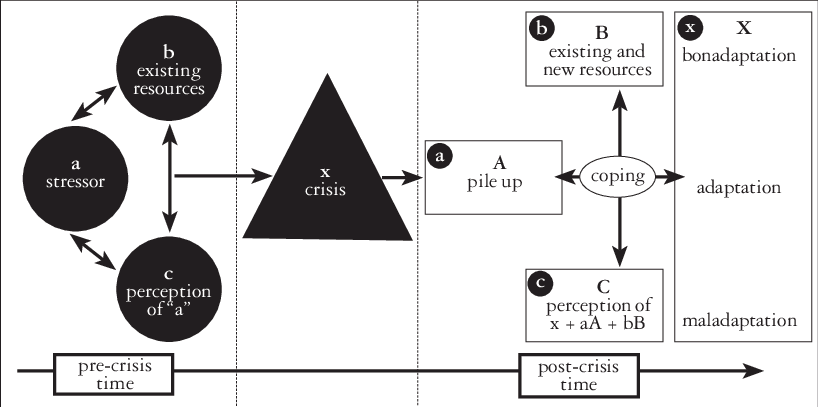
Well a social scientist, Rueben Hill, suggests that there may be a method to the madness, and he calls it the ABCX model.

Family crisis come to every family. That is a just a simple fact of life. Therefore, it is important to understand what crisis really is and how-to best cope with it. The model gives us a pretty good picture.

  • “A” represents the stressor or in other words, the actual event. For example, the death of a loved one or sudden unemployment.
  • “B” represents your resources and how you use them. Some these resources are internal and some of them are external, but all can be used during a time of crisis.
  • “C” is our perception of the stressor, meaning how we cognitively thing about the stressor. Take the example of unemployment as a stressor. Some people may have the thoughts of “Oh my gosh! How are we going to provide for the family now?”, while others may have thoughts of “I am going to start applying to places and we go from there”. Here is another thing to note, different members of the family may have different perceptions of the stressor. I will talk more about that in a second.
  • When “A + B + C” happens, it equals “X” or our crisis.

Now that I have explained the model, let break the segments down a little bit. Let first talk about stressors.

STRESSORS

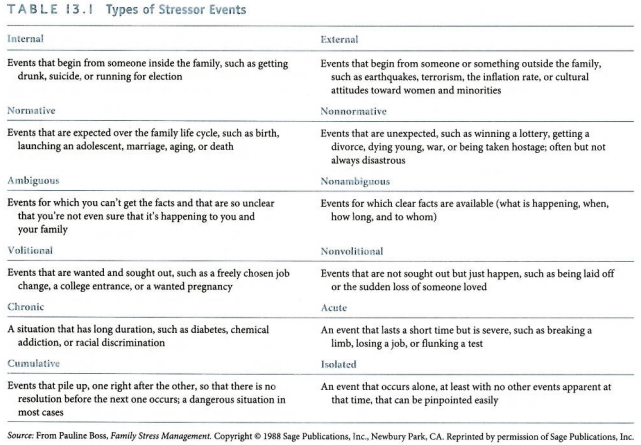
There are many kinds of stressors that can manifest themselves in different forms and at different times throughout our lives. When it comes to family, social scientist have identified nine top types of stressors.

The have called them the Family Inventory of Life Events and Change or FILE for short. These are the top nine stressors.

  • Intrafamily strain
  • Marital strain
  • Pregnancy and childbearing strain
  • Finance and business strain
  • Work-family transition and strains
  • Illness and family care strains
  • Family losses
  • Family transitions in and out
  • Family legal strains

Not all of these stressors end up being a family crisis, but they could develop into one depending on the duration, the condition the stressor occurred, and the severity.

This chart explains a little bit more about the different stressor events.

Identifying the stressor and the stressor event is vital in managing family crisis.

RESOURCES

When a family is faced with a stressor, it is important that they take inventory of their resources, both internal and external. External resources could be extended family, church communities, financial status, education, food resources, support groups other than family and church, etc. Internal resources are more likely to be the family’s strengths such as humor, love, compassion, support, listening, time, cooking skills, etc. A family approaching a crisis should take inventory of these resources and create a plan to use them.

PERCEPTION

Like I mentioned before, different family members can have different perceptions of the same event. Here is an example of a smaller stress. It is Saturday morning and its little brother’s soccer game. Mom is rushing about, thinking how late they are going to be. Dad is taking a short nap on the couch. He does not notice mom rushing about and he thinks the game starts an hour later than when it actually starts, so he is not worried. Sister is in her room, trying to put the finishing touches on her project that is due Monday. Mom notices dad and becomes annoyed. She snaps at him and tell him to get up and help. He is taken back by her sudden annoyance and shoots back a snide remark. Mom get offended and stalks off to sister’s room and begins to yell at her for not being ready to go. Sister, who is already under stress, snaps back. Now the whole family is fighting and little brother is late to his game.

What could have been different? They could have tried to understand each other’s perceptions before making inferences. Individuals view stressors differently, so as a family, it is important to make sure everyone is on the same page with the perception of the stress.  

CONCLUSION

The best method I know on how to manage a family crisis, is to remember that it is a family matter. Hold councils together. Make plans together and make sure everyone is involved. With children, only tell them what they need to know, but do not exclude them either. The reason why I have close relationship with my family is because of crises! Crises do not have to destroy…they can also build. You choose.  

It Is Better to Wait

Imagine you are at the store and you are standing in front of your favorite candy bar (Mine is Reeses). You know you should buy it, you even have the money in your pocket! But you know how good that candy bar tastes and that makes you want to eat it…right now! Eventually, you can’t take it any longer, so you grab it off the shelve, rip the wrapper, and proceed to shove its contents in your mouth. Right as your about to finish the remainder of the candy bar, the manager of the store walks around the corner and spot you. With a mixture of anger and surprise, he walks up to you and demands to know what you are doing. With bit of candy bar around your mouth, you just stare back at him because you cannot think of an intelligent way to tell him that you were planning on buy it. You now feel stupid as you fumble over your words for any explanation to your actions. The candy bar all the sudden doesn’t taste as good as it begins to settle into the pit of your stomach.

Okay so what was the point of having you imagine all of that. Well, today my topic is on sexual intimacy and I am going to use the analogy of the unbought candy bar.

For some people, talking about or even saying the word sex is just as bad as dropping the f-bomb. Especially for those who have not engaged in sexual intimacy, it could be perceived as something dirty and secretive. Here is the thing, just like the candy bar, sex in itself is very pleasurable and lovely thing. There is nothing dirty or wrong about it, but it how and when you decided to engage in it that keeps it lovely.

Let’s take the analogy of the candy bar.

The candy bar will taste better and be associated positive emotions, if it is bought before it is eaten. Why? Because of the effort you have put in. This is the same with sexual intimacy. Sex would just be sex if there is no effort to make it intimacy.

Let me define intimacy.

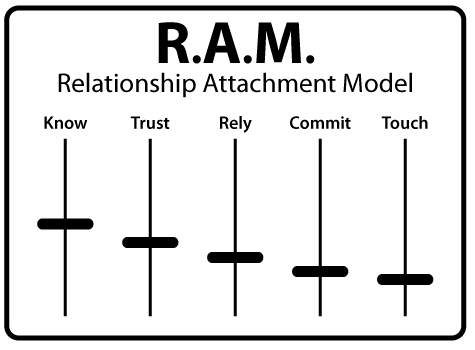
“Intimacy is feelings of emotional closeness and connectedness with another person and the desire to share each other’s innermost thoughts and feelings. Intimate relationships are characterized by attitudes of mutual trust, caring, and acceptance”, according to optionsforsexualhealth.org. This can only be achieved by really getting to know someone, trusting them, relying on them, making commitments, and then incorporating physical touch, or in other words, the R.A.M. model.

(If you want further explanation of the R.A.M. Model, then follow this link to my previous blog post, https://thelab.family.blog/2019/02/17/taking-the-fear-out-of-dating/)

As human beings, we long for a closeness with others. We long to be intimate. Sex is a need that we have, but it isn’t just used to get pleasure, it should be used to become more intimate with the other person. The best way to use sex is in marriage.   

I am not trying to be old fashion here or even religious! Studies have proven that those who engage in sexual relations within the bonds are marriage are more satisfied with their sexual relationship than those who engage in sexual relations outside marriage. Why is this? Again, it is all about intimacy and the effort you have made to create intimacy.

Some of you may be thinking “well, what about cohabitation? It’s basically like marriage so there should be the same benefits”. Not true. Studies have shown that those who cohabitate and have sexual relations are less satisfied with the sex and the relationship in general. Commitment brings security which allows intimacy to grow and sex with no intimacy is of little to no value.

So yes, if you are looking for a satisfying experience, it is better to wait.

I can hear the bells!

There is a moment that almost every girl dreams about; the wedding. They talk about it, day dream about it, and then talk about it some more. No, we are not obsessed with it, but we would be lying if we didn’t admit that we don’t look forward to it.

It funny how much we are prepare for the actual event but how little we prepare for what the event indicates. A union of two people. A merging of two lifestyles.

That is a rather daunting task!

It takes more than just a proposal, engagement, and wedding to make a marriage. It takes creating a foundation to make a steady marriage that will withstand the storms. The proposal, engagement, and wedding can be an important part of this foundation if we use them in the correct ways.

Here are somethings that can make or break your marriage.

  1. The proposal

There are some false beliefs and true beliefs that center around the proposal. The first being about the engagement ring.

No, men. Bigger is not always better. Sometimes, smaller is actually tons better and healthier for your marriage. There is a correlation between the cost of wedding ring and the likelihood of divorce. According to NBC News, women who received engagement rings costing over 2,000 dollars were 1.3 more likely to divorce then women who receive an engagement ring between cost 500 and 2,000 dollars. This being said, don’t go too cheep boys, because the data also states that men that spend less than 500 dollars are also found to deal with higher divorce rates.

The second is the whether the man should just pop the question without discussing marriage with the women or should there be a discussion first?

A growing trend among young adults considering marriage is setting the date before the proposal has been ever made. Some may argue that this growing trend me be part of the reason why some marriages end in divorce. You see, studies have shown that women are less likely to divorce if they can look back with fondness at the way the marriage started, and there is something about a man taking a chance that she might say no but proposing anyway that makes a woman back with more fondness. Just a something to consider.

2. The engagement

Most people think that the engagement period is for planning the wedding, the reception, and the honeymoon, but engagements would be more beneficial if they are used to plan the marriage. What I mean by this is that bringing two different background together and expecting them to work in harmony is not going to happen overnight. It is a process. The engagement period gives you time to create a smoother transition. Instead of talking about wedding colors, maybe it would be better to talk about how you are going to merge your finances and who will take care of the bills. Instead of figuring out many bridesmaids, it would more beneficial to discuss how many hours you both are going to need to use for jobs, school, or other activities, and how many you will promise to give to your spouse.

It is worrisome that most people my age talk more about the wedding than what happens after the wedding. This time should really be used to prepare for marriage, not for the wedding.

3. The wedding and reception

Studies have shown with along with the cost of an engagement ring, the cost of a wedding also have a correlation with the rate of divorce. Those with a wedding costing 20,000 or more have a 1.6 higher rate of divorce that those who spend 5,000 to 10,000. Then those who spend 1,000 or less have a rate below the average.

How much money is put into the wedding is not important. What is more important is having support from many friends. Those who have a good support system have a lower chance of getting divorced, so here is a suggestion.

Keep the cost low and the number of people you invite high, then have them help with the reception! Let some them DJ! Have others help with the decore! The more they are connected to the couple and the event, the more likely they are to offer their support.

There you have it! Build a strong foundation for your marriage…not just your wedding.

Taking the Fear Out of Dating

When I got home from my mission and my ward members found out that I would be going to BYU-I, the teasing was nonstop.

“I wonder what your last name will be when you get back.”

“Can’t wait to meet the husband when you come back.”

“So how long do you think she will last? Two weeks?”

Nonstop! Every time I went to church, at least one of these types are comments where made. It was enough to drive someone crazy! Here I was a newly returned RM, barely getting a handle on life, and now I was expected to get married to first eligible bachelor.

Talk about anxiety inducing.

I went off to school dreading and fearing dating but thank goodness for amazing professors and an amazing sister. My sister had persuaded me to sign up for a class called “Preparation for Marriage”. I at first thought she was just as bad as the members of my ward but turns out that she was just wise. That class ended up being one of my favorite classes and this past week, I was able to review some of the things that I had learned.

Therefore, all my stressed-out single people, take a deep breath. I am about to take most of the fear out of dating. Let me introduce you to the R.A.M.

The R.A.M. is actually called the Relationship Attachment Model. It was created by John Van Epp to help provide a guideline in to creating healthy relationship. Attached below is a picture of the model.

This is how you interepret the R.A.M. Think as it more as levers rather them levels or steps. Each lever needs to be raised before the one after it can be raised, and it always goes in the order of know, trust, rely, commit, and then touch.

  1. Know

To know doesn’t mean to just know what they like to do in their spare time or what is their favorite color. To know means to really have seen them in all sort of situations and had many different types of experiences with them to get an idea of their character. My teacher told us that we could measure know by a simple equation (Together + Talk + Time = Know). We cannot cheat time when it comes to getting to know each other and we cannot rush it either. Seeing someone everyday and hanging out does not equal getting to know them. It just shows you what they are like in one situation. Someone who dates wisely will place their date in many different situations. That is truly getting to know someone.

  • Trust

Trust come after knowing someone. The more you get to know them, the more you know if you can trust them. When we know someone is reliable, it is a good idea to start mutually self-disclosing. Now don’t dump your whole life story on them, but it is alright to share some things. Vulnerability creates closeness.

  • Rely

Naturally, you are going to begin to rely on them for emotional support when you begin to be vulnerable, but it should be appropriate for knowledge you have of them and how much you trust them.

  • Commit

Again, it should be a natural thing, but sometimes it gets pushed way ahead of the others, especially in the BYU-I culture. Make commitments that are appropriate, such as commitment of time for a date or a commitment to a relationship when you have gotten to know each other. Then of course there is the big commitment of marriage that should never be rushed into. Take your time on the other three aspects of a healthy relationship and commitment will come naturally.

  • Touch

There are several reasons why this is the last lever that should be moved in the R.A.M., but many people that I know try to use it as the first lever. Physical touch creates attachment and bonding, more so for females because it releases the chemical Oxytocin. Oxytocin is the chemical for bonding. For women, it is released more frequently and in larger quantities, therefore women bond quickly with physical touch.  

So what if we introduce it to early? We may become attached to someone who we don’t really know or who we don’t trust or can rely upon! Now that is scary! This is why it should always be last.

When I learned about the R.A.M., my fear of dating lessened. It all about making relationships and not all of them need to be romantic. It is the smart way to date.

Born this Way?

I already know that this post is going to be an uncomfortable for many people, but new information and research has been presented to me and I would like to share.

Today I am going to write about same sex attraction according to some of the research that has been brought to my attention.   The research suggests that maybe people are not born homosexual, but they rather develop it.  

Take a little boy for an example. He was born to a typical family unit consisting of a mother and a father. As a toddler, he did not display as many aggressive or competitive behaviors that are more typically found in young males. In fact, he is considered quite passive compared to his peers. On his first day of elementary school, instead of wanting to go and play outside with the other boys, he prefers to stay indoors and draw with the little girls. This begins a pattern during his elementary years that cause him to be alienated by his male peers since he does not engage in the same activities as them that would create friendships. As he begins to grow, the rift grows larger. He finds that he has trouble connecting with other boys and even his own brothers, and maybe even his own father because he does not have those same shared the same experiences. With this rift come a longing for connection or non-sexual intimacy. His longing for connection is fulfilled to some degree by his female friends, but not fully satisfied. As this disconnect increases, he finds himself longing for a connection in specific with his male peers. One day, around 8th grade, out of the blue, one of the boys start to talk to him and he begins feels something he has never felt before. It is a new and exciting sensation and to be honest, it makes him want to be physically close to this boy. It is such a powerful emotion that it almost scares him, and he begins to question why he feel such a strong desire to be close this other boy. It is around this time that new ideas and concepts are being introduced to him, one of them being homosexuality. He begins to wonder if this is an explanation for why he has this new desire. By the time he has graduated high school, he has positively identified himself as homosexual or gay. He has found who is and now he will find fulfillment through relationships with other men. End of story

This would be the end of the story if it wasn’t for Dean Byrd’s theory.

Dean Byrd was one of the first therapist to work with individuals who struggled with homosexuality and were seeking help. He developed a theory, which a called a developmental theory of sexual orientation, and I found it to be quite intriguing. I have attached a picture of the model below.

According to this model, sexual orientation can be developed instead of it being thrust up someone. Let’s take the story of the little boy for example and compare him to this model. Biologically, he was born male, but his temperament was a bit abnormal for a young male. He preferred to be creative instead of do more manly things like playing sport. This could be considered atypical activity for a male. Also, he also felt more comfortable with girls since they seam to enjoy more of the things he enjoyed. In consequence, the other boys did not connect with him as well as the girls did. He was alienated and grew up with being told that he is different to the point that he believes it. Naturally he is going to have a longing to be accepted and close to those who have rejected him, in this case other males, and when another male interacts with him there will naturally be a sense of arousal. It is thrilling to be accepted by those who have rejected you for so long, but some may get this thrill confused with a sexual thrill. According to this theory, it is around this time that the same-sex orientation is developed and then carried into adulthood.

Dean Byrd, along with other therapist, presented this theory to their clients who were wanting to change their sexuality and it had a surprising effect. Many of them have changed their sexuality from homosexuality to heterosexuality, which has been seen to have a correlation with better mental health and greater happiness.

There is still the question of is it possible to be born homosexual. Though Social Science has not proved it is not possible, they have proven genetics were not a contributing factor. Social Scientist created twin studies and what they found was that if one twin was gay, then there was only a 52% percent chance that the other will be gay. Among identical twins, it should be a hundred percent.

Just some interesting theories to consider.

We are not much different after all.

I had a very moving experience this week.

During our family relations class, our teacher asked for some volunteers for a demonstration. I volunteered and I was placed as the mom. A few more students were chosen until we had a complete family of two children, a mom and dad, an uncle and aunt, a cousin, and a grandma. We then were told what we would be portraying. We were going to portray a typical family located in Mexico.

I won’t lie at first, I was a little confused about how this tied into family relations, but as our story began to unfold, I began to understand the connection. In the beginning we were a big closely-knit family.

Our teacher explained to us that most of the men that work down in Mexico are quite skilled craftsmen. They are the main provider of the family and the mothers usually stay home and take care of the kids. That is what our little group of students were supposed to portray until our teacher announced that my husband and I had made the decision to move to the United States. For this to happen, our husband and father had to leave before us and we would not see him for at least a year, if not more. On that happy note, my “husband” left my side and even though it wasn’t real, I felt a strong emotion began to well up in me. I felt loss. I found myself think about my two kids and the additional responsibility that lay ahead. I didn’t realize how nice it was to have someone else just standing beside me until he moved to the other side of the room, then I didn’t have it anymore. Without meaning to, my “daughter” and I ended up standing closer together as my “son” drifted further away. It was so interesting to see that just by my husband leaving, there was distance created between me and my son. Our teacher then moved out relatives close to us and it seemed to fill the hole. That is until he announced that we would now be joining our husband and father in the United States. Our aunt started to cry, and I did not blame her.

He then explained the complexity of crossing the border. Stories that I had heard about, but I was not sure if they were true. Turns out that most of them are fact such as it was a fact that some people never make it to the border because they die along the way. He also told us that rape is not uncommon or sex trafficking. There are quite few women who had to endure this in order to be reunited with their husbands and then when they were finally reunited with their spouse, it is not always met with happy tears and shouts of joy. There is quite a bit of adjusting that needs to go on.

What I noticed was how unnatural it was to stand next to my “husband” and my kids also kept a distance from him. It was as though he was a stranger to us even though he only left fifteen minutes prior. Also, I could feel the strain as we tried to figure out who played what role in the family again. Our family was not the same as it was at the beginning of the demonstration and it was curious to feel the difference…because it was just supposed to be pretend. Wasn’t it?

I never realized how hard it was for families to leave their homeland but most importantly their connections. Their aunts, uncles, cousins, grandmas, grandpas, nieces, and nephews. It is heartbreaking. What is more heartbreaking is seeing what time and distance can do to even the closest-knit families. It messes with the roles. It creates uncertainty with in the family. Bonds are broken that should never be tampered with.

It opened my eyes to how it doesn’t matter what culture you are from, what language you speak, or where you live, family is the basic unit. I felt the absence of my pretend family when they left me because that is how humans are. We are meant to be in family units and keep those units together.

Something I have always loved about the Latino culture is their desire to keep close ties with their family members. Those relationships are the most important to them and they put those as priority. I want to incorporate this value into my own family.

I believe there is something to be learned when we began to love and respect the families of various cultures. We gain greater insight into what family should be.

What are some aspects that you admire about other cultures that you would like to incorporate in your family? Comment below.