
We have all met an elderly couple who joyfully talk about hard times and seem closer because of it. If you are the average human, you are probably wondering “what gives?”. Either these elder people are off their rocker or there is a method to their madness.
Well a social scientist, Rueben Hill, suggests that there may be a method to the madness, and he calls it the ABCX model.
Family crisis come to every family. That is a just a simple fact of life. Therefore, it is important to understand what crisis really is and how-to best cope with it. The model gives us a pretty good picture.
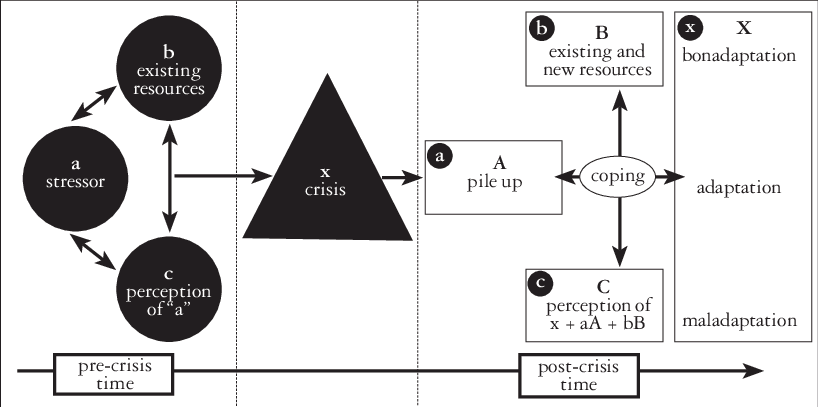
- “A” represents the stressor or in other words, the actual event. For example, the death of a loved one or sudden unemployment.
- “B” represents your resources and how you use them. Some these resources are internal and some of them are external, but all can be used during a time of crisis.
- “C” is our perception of the stressor, meaning how we cognitively thing about the stressor. Take the example of unemployment as a stressor. Some people may have the thoughts of “Oh my gosh! How are we going to provide for the family now?”, while others may have thoughts of “I am going to start applying to places and we go from there”. Here is another thing to note, different members of the family may have different perceptions of the stressor. I will talk more about that in a second.
- When “A + B + C” happens, it equals “X” or our crisis.
Now that I have explained the model, let break the segments down a little bit. Let first talk about stressors.
STRESSORS
There are many kinds of stressors that can manifest themselves in different forms and at different times throughout our lives. When it comes to family, social scientist have identified nine top types of stressors.
The have called them the Family Inventory of Life Events and Change or FILE for short. These are the top nine stressors.
- Intrafamily strain
- Marital strain
- Pregnancy and childbearing strain
- Finance and business strain
- Work-family transition and strains
- Illness and family care strains
- Family losses
- Family transitions in and out
- Family legal strains
Not all of these stressors end up being a family crisis, but they could develop into one depending on the duration, the condition the stressor occurred, and the severity.
This chart explains a little bit more about the different stressor events.
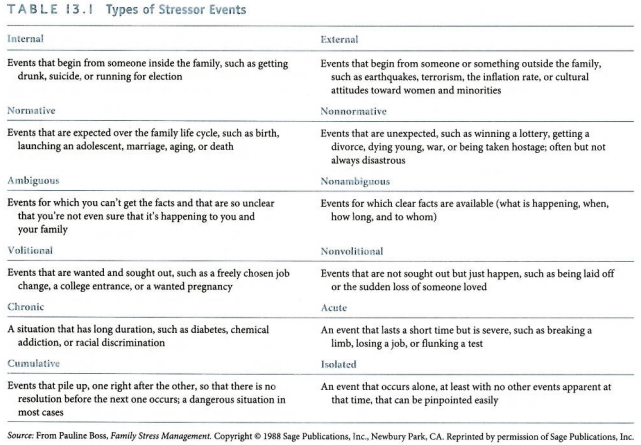
Identifying the stressor and the stressor event is vital in managing family crisis.
RESOURCES
When a family is faced with a stressor, it is important that they take inventory of their resources, both internal and external. External resources could be extended family, church communities, financial status, education, food resources, support groups other than family and church, etc. Internal resources are more likely to be the family’s strengths such as humor, love, compassion, support, listening, time, cooking skills, etc. A family approaching a crisis should take inventory of these resources and create a plan to use them.
PERCEPTION
Like I mentioned before, different family members can have different perceptions of the same event. Here is an example of a smaller stress. It is Saturday morning and its little brother’s soccer game. Mom is rushing about, thinking how late they are going to be. Dad is taking a short nap on the couch. He does not notice mom rushing about and he thinks the game starts an hour later than when it actually starts, so he is not worried. Sister is in her room, trying to put the finishing touches on her project that is due Monday. Mom notices dad and becomes annoyed. She snaps at him and tell him to get up and help. He is taken back by her sudden annoyance and shoots back a snide remark. Mom get offended and stalks off to sister’s room and begins to yell at her for not being ready to go. Sister, who is already under stress, snaps back. Now the whole family is fighting and little brother is late to his game.
What could have been different? They could have tried to understand each other’s perceptions before making inferences. Individuals view stressors differently, so as a family, it is important to make sure everyone is on the same page with the perception of the stress.
CONCLUSION
The best method I know on how to manage a family crisis, is to remember that it is a family matter. Hold councils together. Make plans together and make sure everyone is involved. With children, only tell them what they need to know, but do not exclude them either. The reason why I have close relationship with my family is because of crises! Crises do not have to destroy…they can also build. You choose.
 The Family Lab